.svg)
.svg)
.svg)
.svg)
.svg)








Is OPAL Fuels (OPAL) stock Halal?
Verdict for OPAL Fuels (OPAL): not Shariah compliant (FAIL). Screened October 2026 under AAOIFI Shariah Standard No. 21. Business activity: pass. Non-permissible income: pass. Interest-bearing investments: fail. Interest-bearing debt: fail. Preference shares: pass. Dividend purification factor: not applicable. Next review: November 2026.
OPAL Fuels is an energy infrastructure company focused on producing and distributing low-carbon intensity renewable natural gas for the transportation and power markets. The company operates a vertically integrated, waste‑to‑energy model that captures methane emissions from sources such as landfills and agricultural operations, upgrades them into pipeline-quality renewable natural gas, and delivers this fuel primarily to heavy- and medium-duty trucking fleets across the United States. For Muslim investors, though, the most pressing question is simpler: is OPAL Fuels a Halal investment?
Is OPAL Fuels Shariah compliant?
No. In the October 2026 screening OPAL Fuels (OPAL) does not pass AAOIFI screening: it fails the interest-bearing investments and interest-bearing debt screens. Supplying power, gas or water is a permissible service, so utilities like OPAL Fuels rarely trouble the activity screen. The pressure point is the balance sheet: grids and plants are among the most debt financed assets in any market, and AAOIFI Shariah Standard No. 21 caps interest bearing debt at 30% of market capitalisation, the screen that decides most utility verdicts.
Does OPAL Fuels pass the business activity test?
The activity screen is only part of the picture this month: OPAL Fuels currently fails the interest-bearing investments and interest-bearing debt screens, so the overall verdict is not compliant regardless of the business itself. Delivering power or water raises no Shariah objection in itself; the scrutiny belongs to the debt behind the network.
Is OPAL Fuels' income Halal?
Yes, within AAOIFI's tolerance. OPAL Fuels' income from non-permissible sources stays below 5% of revenue in the October 2026 screening.
Does OPAL Fuels meet AAOIFI's debt and investment ratio requirements?
No. Both ratios currently breach the 30% caps, measured against a market capitalisation of $306M (market data as of 1 October 2026): interest bearing investments and interest bearing debt each exceed the limit AAOIFI permits for a Halal investment. The ratios move with the share price as well as the balance sheet, and our Shariah Supervisory Board has OPAL re-screened every month.
Why do other halal screeners show a different verdict for OPAL Fuels?
Screeners can disagree without either being wrong. AAOIFI Shariah Standard No. 21, which Tabadulat applies, measures interest bearing debt and investments against market capitalisation with a 30% ceiling. MSCI and FTSE measure them against total assets with a 33% ceiling, and S&P and Dow Jones Islamic use a multi year average of market capitalisation. Data dates differ too, because each provider reads filings and prices on its own schedule. The same company can therefore pass one standard and fail another in the same month. Tabadulat publishes one answer, the AAOIFI result as of October 2026, and re-screens it every month.
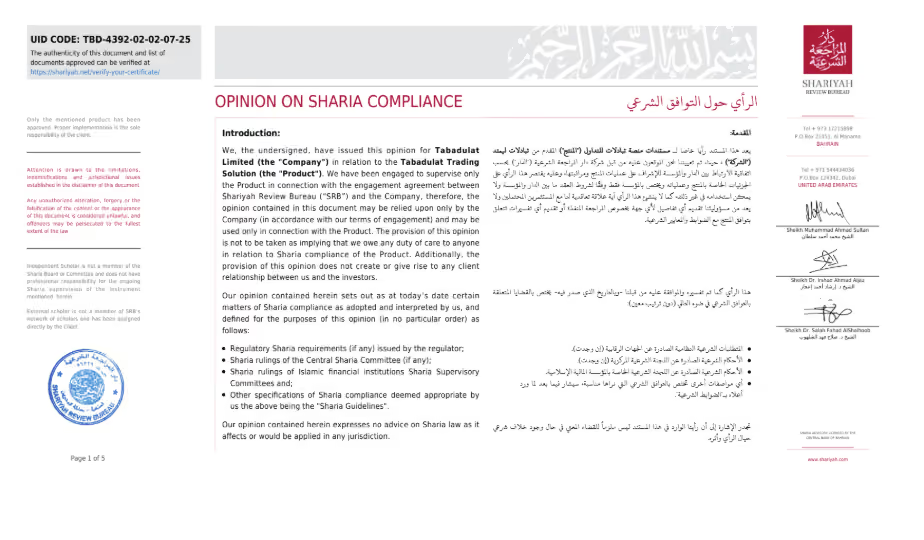
Tabadulat is an ADGM regulated brokerage whose license covers Shari'a Compliant Regulated Activities, as the FSRA permission names them. New to the terminology? Gharar and Maysir, Sukuk, Zakat and purification are all explained in plain English.
New to the screening method? Read What is Riba? A Clear Guide for Ethical Muslim Investing
Frequently asked questions
Is OPAL Fuels (OPAL) stock Halal to invest in?
.svg)
.svg)
How often is OPAL Fuels (OPAL) reviewed for Shariah compliance?
Does OPAL Fuels (OPAL) pass the AAOIFI non-permissible income screen?
Does OPAL Fuels (OPAL) pass the AAOIFI interest-bearing investments screen?
Does OPAL Fuels (OPAL) pass the AAOIFI interest-bearing debt screen?
What is the dividend purification factor for OPAL Fuels (OPAL) stock?
Does OPAL Fuels (OPAL) pass the AAOIFI preference share screen?