


.svg)
.svg)
.svg)
.svg)
.svg)
Why Your Savings Matter (And Why They Shouldn't Just Sit There)
How intentional, Shariah-compliant saving turns idle cash into Halal growth.


Jul 8, 2026
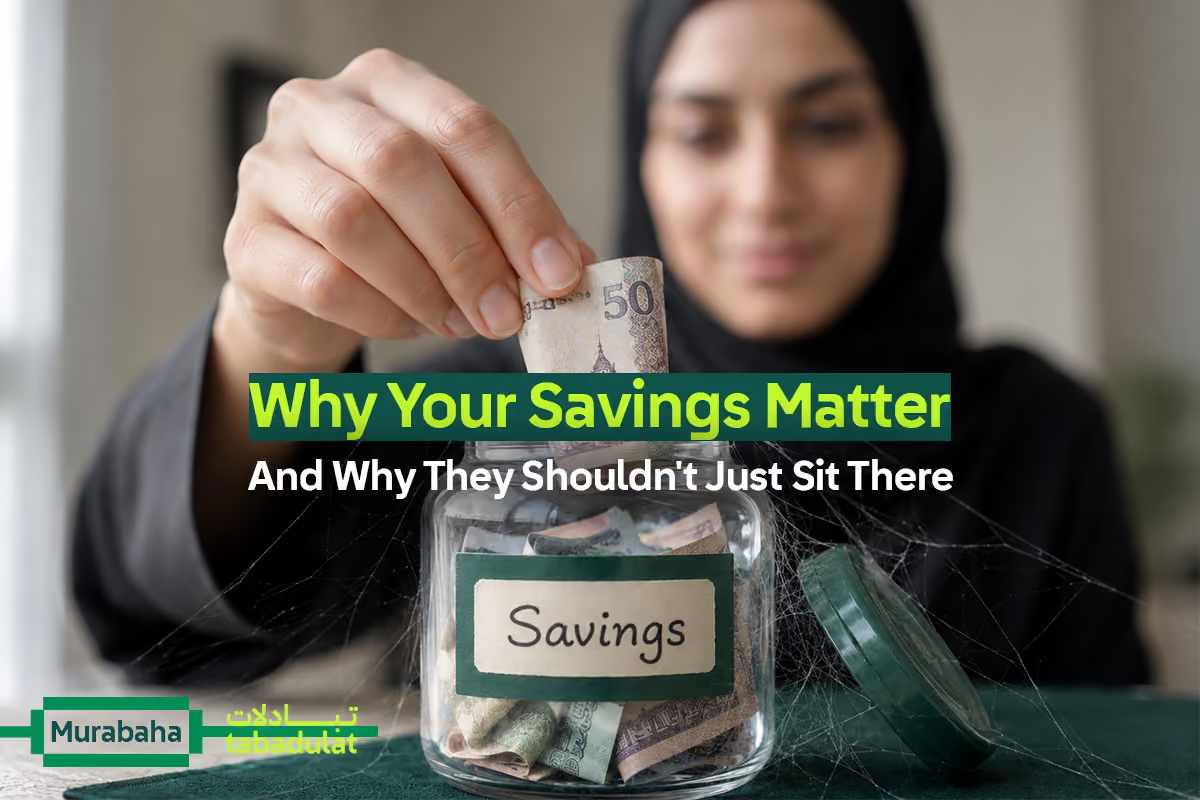
Most of us were raised with one piece of financial advice: save your money. What we weren't always taught is what happens to that money once it's saved. For many Muslims, cash sits in a conventional bank account for years, technically "safe," but doing nothing, and in some cases, quietly sitting in a system built on interest (riba), something Islam explicitly warns against.
This article looks at why saving with intention matters, what happens when money is left idle, and how a Shariah-compliant tool like a Murabaha savings lets your savings work for you without compromising your values.
The Problem With "Just Saving"
Putting money aside is a good habit. But there's a difference between saving and saving intentionally. When cash sits untouched in a low- or zero-return account, it loses purchasing power to inflation over time, and it misses the chance to grow through any real economic activity.
For Muslims, there's an additional layer: many conventional savings and current accounts pay or charge interest, which is not permissible in Islamic finance. Harvard Law School's Islamic Law notes that the prohibition on riba is rooted directly in Quranic injunctions and classical jurisprudence, and forbids any guaranteed monetary gain from lending. That leaves a real gap; people either accept a product that conflicts with their values, or they leave money completely idle to avoid it. Neither outcome serves long-term financial well-being.
Saving With a Purpose
Intentional saving means treating your money as a tool with a job to do, whether that's an emergency cushion, a future purchase, or long-term wealth preservation. A simple way to think about it: every paycheck effectively has three jobs, covering living expenses, building savings, and investing for the future. When savings are left out of that equation, or parked somewhere that generates no Halal benefit, the "saving" step stops pulling its weight.
This is where Shariah-compliant instruments like Murabaha savings come in. Rather than lending your money out for interest, a Murabaha savings use your funds in a real, asset-backed trade transaction. The institution purchases a tangible asset (such as a commodity) and sells it at an agreed, transparent markup. The expected profit you receive comes from that trade, not from a loan.
What Idle Money Actually Costs You
It's easy to underestimate the cost of doing nothing. Consider two scenarios:
- Money left idle: Value slowly erodes with inflation, and there is no participation in productive economic activity.
- Money placed in a Murabaha savings: Funds are used in a real trade transaction, with an expected profit agreed upfront, while capital is preserved through a structured, lower-risk process.
The second option doesn't just protect your money from doing nothing; it keeps it aligned with Islamic principles the entire time.
Starting Small Still Counts
One misconception is that Halal savings tools are only for the wealthy. In practice, Shariah-compliant savings structures can start from modest amounts. For example, Murabaha savings plans can begin from as little as USD 1,000 for a one-month term, scaling up to larger amounts and longer terms for those preserving significant wealth. This tiered structure means a first-time saver building an emergency fund and a family office managing corporate treasury can both use the same underlying Halal mechanism, just at different scales. It also reflects a broader industry trend: the Islamic Financial Services Board's 2025 Stability Report points to renewed double-digit growth across Islamic banking and deposits, a sign that more savers are actively choosing Shariah-compliant alternatives rather than settling for interest-based defaults.
Why This Matters for Muslims Specifically
The Quran is direct about the prohibition of riba, describing it as unjust and harmful to society. That's not a minor technicality; it shapes how observant Muslims are expected to handle every financial decision, including where they park their savings. Choosing a Murabaha savings over a conventional interest-bearing account isn't just a preference; for many, it's a matter of religious obligation and peace of mind.
The Bottom Line
Your savings are only as valuable as the job you give them. Left idle, cash quietly loses value and sits outside the bounds of Halal financial practice. Placed intentionally into a Shariah-compliant structure like a Murabaha savings, the same money can generate expected profit through real trade, stay accessible on flexible terms, and remain fully aligned with your values.
Explore more: New to the basics of Murabaha? Read our companion piece, Murabaha Savings Explained: A Guide to Islamic Savings Accounts, for a full breakdown of how the structure works. For the bigger picture on Shariah-compliant wealth building, see What is Halal Investing? Everything You Need to Know.
https://tabadulat.com/blog/murabaha-deposits-explained-a-guide-to-islamic-savings-accounts
Sources
- Young, J. "Murabaha: Definition, Example, and Financing Under Islamic Law." Investopedia. https://www.investopedia.com/terms/m/murabaha.asp
- "Navigating the Prohibition of Ribā in the Modern Islamic World." Islamic Law Blog, Harvard Law School Program in Islamic Law. https://islamiclaw.blog/2025/01/14/navigating-the-prohibition-of-riba-in-the-modern-islamic-world/
- "An Essential Guide to Building an Emergency Fund." Consumer Financial Protection Bureau (CFPB). https://www.consumerfinance.gov/an-essential-guide-to-building-an-emergency-fund/
- "Islamic Financial Services Industry Stability Report 2025." Islamic Financial Services Board (IFSB). https://www.ifsb.org/press-releases/islamic-financial-services-industry-stability-report-2025-need-for-coordinated-action-to-deepen-markets-and-sustain-growth-momentum/
- Accounting and Auditing Organization for Islamic Financial Institutions (AAOIFI), Shariah Standards. https://aaoifi.com/shariah-standards-3/?lang=en
- "Introduction to Murabaha." Blossom Finance. https://www.blossomfinance.com/posts/introduction-to-murabaha
:
This article is for educational purposes and does not constitute financial or investment advice. Readers should consult a qualified Shariah scholar and/or financial advisor before making investment decisions
Read more
Browse all articles


.avif)