.svg)
.svg)
.svg)
.svg)
.svg)





Can Your Savings Grow the Halal Way?
Your savings can grow the Halal way through structures that avoid Riba and generate permissible profit, such as Commodity Murabaha. Choosing a savings product means checking its structure, minimum amount, term, access conditions, profit basis and risks against your goal and timeframe.
What Is Halal Saving?
Saving is not only about putting money aside. It is also about protecting its purpose and choosing where it sits.
You may already save for emergencies, travel, education or a major purchase. But there is another question for Muslim savers: where should that money sit while you are waiting to use it?
Halal saving means setting money aside in a way that avoids Riba and follows Shariah principles, while still matching the goal and timeframe you are saving for.
In this lesson, you will learn why idle cash can lose purchasing power, how Halal saving differs from conventional interest-based saving, and how Commodity Murabaha can be used as a Shariah-compliant savings structure.
Why does saving matter?
Saving gives short-term money a clear job. It can help you prepare for unexpected costs, planned purchases and goals that may be too close to rely on longer-term investments.
Emergencies
Money for unexpected expenses.
Planned goals
Travel, education or a major purchase.
Short-term needs
Money you may need before a longer-term investment has time to grow.
What happens when cash just sits there?
Keeping money aside can protect the amount you see in your account, but it does not necessarily protect what that money can buy. Over time, inflation can reduce its purchasing power.
Today
$1,000 buys a certain basket of goods.
Prices rise
The same goods become more expensive over time.
Later
$1,000 may buy less, even though the number has not changed.
Inflation does not mean your cash balance disappears. It means the same amount of money may buy less over time.
So what makes saving Halal?
For a Muslim saver, the issue is not only inflation. The way any return is generated also matters.
Conventional interest-based saving
The return is interest paid on money deposited or lent. Riba is prohibited in Islamic finance.
Halal saving
The structure avoids Riba and generates permissible profit through a Shariah-compliant mechanism, such as real trade.
The key question is not simply "Does my money earn a return?" It is "Where does that return come from?"
What is Commodity Murabaha?
Commodity Murabaha is one way Halal savings can be structured. Instead of lending money in exchange for interest, the return is linked to a real trade transaction with a disclosed cost and profit margin.
The terminology can sound complicated, but the basic flow is simple:
- You provide funds
- A real asset is purchased
- The asset is sold at an agreed markup
- You receive capital + agreed profit
A simple $1,000 example
Imagine you place $1,000 into a Commodity Murabaha savings arrangement. The funds are used as part of a real asset transaction. The cost and profit margin are disclosed according to the contract, and at the end of the agreed term you receive your capital plus the agreed profit, subject to the product terms.
The profit comes from a sale transaction, not from charging interest on a loan.
What could that look like over time?
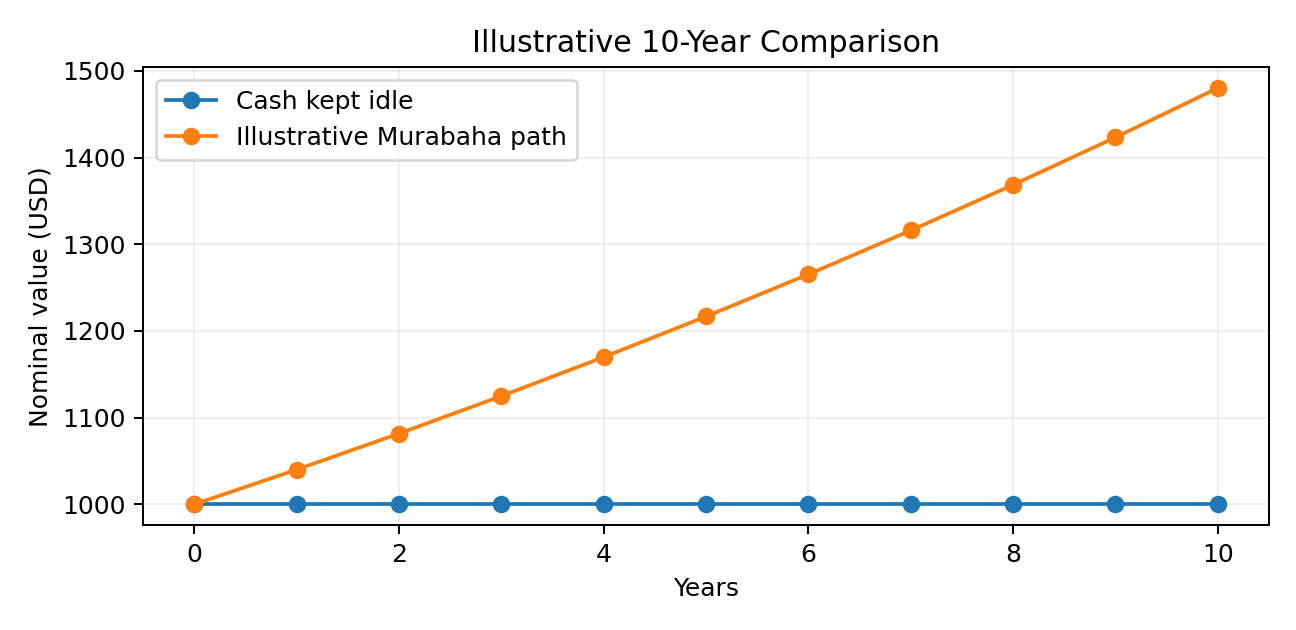
The chart below is only an educational illustration. It compares $1,000 left unchanged in cash with a hypothetical path where a 4% annual Murabaha profit is repeatedly reinvested for 10 years. It is not a Tabadulat product rate, forecast or guarantee.
Illustrative assumptions: $1,000 starting amount, 4% annual profit, annual reinvestment, no fees or taxes. Actual Murabaha terms and profit rates vary.
A chart can show how earning and reinvesting permissible profit may change a nominal balance. Inflation is a separate factor and can still affect real purchasing power.
How much should you keep in savings?
There is no single amount that suits everyone. The purpose of the money matters. Savings are generally for goals where access, timing and capital preservation matter more than taking investment risk for higher potential growth.
Savings
- Emergency needs
- Known upcoming expenses
- Shorter time horizons
Investing
- Longer-term goals
- Potential wealth growth
- Greater exposure to investment risk
What should you check before choosing a Halal savings product?
A product being described as "Islamic" or "Halal" does not mean you should skip the details. Before committing your money, understand how the product works and whether it fits your goal.
01 Structure
How is the profit generated and what Shariah contract is being used?
02 Minimum amount
How much do you need to start?
03 Term & access
How long is the money committed and what happens if you need it earlier?
04 Profit & risks
Is the profit agreed or expected, and what risks or conditions apply?
From Halal saving to Riba
Halal saving makes one principle especially important: a return should not simply come from lending money for interest. But Riba can appear in more places than a savings account, including some financial products and transactions.
Test your knowledge
Question 1 of 3
Why can idle cash lose purchasing power over time?
- A. Because the number in your account automatically falls every year.
- B. Because inflation can make goods and services more expensive.
- C. Because saving is the same as investing.
Correct answer: B
Question 2 of 3
Where does profit in a Commodity Murabaha structure come from?
- A. Interest charged on a loan.
- B. A permissible asset trade with an agreed markup.
- C. A guaranteed rise in the price of the commodity.
Correct answer: B
Question 3 of 3
What should you check before choosing a Halal savings product?
- A. Only the advertised profit figure.
- B. Only whether the product uses the word Halal.
- C. The structure, minimum amount, term, access conditions, profit basis and risks.
Correct answer: C
Sources
- Tabadulat – Why Your Savings Matter (And Why They Shouldn’t Just Sit There)
- Tabadulat – Murabaha Savings Explained: A Guide to Islamic Savings Accounts
- Tabadulat – Murabaha Savings Made Simple
- Tabadulat – Islamic Savings
- IG Academy – Trading Commodities (Lesson Structure Reference)
Educational content only. This lesson does not constitute investment advice.
Frequently asked questions
What is Halal saving?
Halal saving means setting money aside in a way that avoids Riba and follows Shariah principles, while still matching the goal and timeframe you are saving for.
Why can idle cash lose purchasing power?
Inflation can make goods and services more expensive over time. The same cash balance may buy less, even though the number in your account has not changed.
Where does Commodity Murabaha profit come from?
The profit comes from a real asset sale transaction with a disclosed cost and agreed profit margin, not from charging interest on a loan.
Is the illustrated 4% annual Murabaha profit guaranteed?
No. The 4% annual profit is a hypothetical educational illustration, not a Tabadulat product rate, forecast or guarantee. Actual Murabaha terms and profit rates vary.
What should you check before choosing a Halal savings product?
Check how profit is generated, the Shariah contract, the minimum starting amount, the term and access conditions, whether profit is agreed or expected, and the risks or conditions that apply.
Related terms
Key takeaways
- Saving gives short-term money a purpose, such as emergencies, planned purchases or upcoming expenses.
- Inflation can reduce the purchasing power of idle cash over time.
- Halal saving avoids Riba and uses Shariah-compliant structures to generate permissible profit.
- Commodity Murabaha is trade-based: a real asset is bought and sold at a disclosed markup rather than money being lent for interest.
- Before choosing a savings product, check its structure, minimum amount, term, access conditions, profit basis and risks.
- Saving and investing serve different purposes, so the right place for your money depends on your goal and timeframe.
Put this lesson into practice
Check any stock's Shariah status for free, then invest the halal way with Tabadulat.
{"@context":"https://schema.org","@graph":[{"@type":"LearningResource","name":"Can Your Savings Grow the Halal Way?","description":"Learn how Halal saving avoids Riba, how Commodity Murabaha generates trade-based profit, and what to check before choosing a suitable savings product.","url":"https://www.tabadulat.com/academy/can-your-savings-grow-the-halal-way","inLanguage":"en","learningResourceType":"Lesson","educationalLevel":"Beginner","isAccessibleForFree":true,"isPartOf":{"@type":"Course","name":"Introduction to Halal Investing","url":"https://www.tabadulat.com/academy-course/introduction-to-halal-investing","provider":{"@type":"Organization","name":"Tabadulat","url":"https://www.tabadulat.com"}},"publisher":{"@type":"Organization","name":"Tabadulat","url":"https://www.tabadulat.com"}},{"@type":"FAQPage","mainEntity":[{"@type":"Question","name":"What is Halal saving?","acceptedAnswer":{"@type":"Answer","text":"Halal saving means setting money aside in a way that avoids Riba and follows Shariah principles, while still matching the goal and timeframe you are saving for."}},{"@type":"Question","name":"Why can idle cash lose purchasing power?","acceptedAnswer":{"@type":"Answer","text":"Inflation can make goods and services more expensive over time. The same cash balance may buy less, even though the number in your account has not changed."}},{"@type":"Question","name":"Where does Commodity Murabaha profit come from?","acceptedAnswer":{"@type":"Answer","text":"The profit comes from a real asset sale transaction with a disclosed cost and agreed profit margin, not from charging interest on a loan."}},{"@type":"Question","name":"Is the illustrated 4% annual Murabaha profit guaranteed?","acceptedAnswer":{"@type":"Answer","text":"No. The 4% annual profit is a hypothetical educational illustration, not a Tabadulat product rate, forecast or guarantee. Actual Murabaha terms and profit rates vary."}},{"@type":"Question","name":"What should you check before choosing a Halal savings product?","acceptedAnswer":{"@type":"Answer","text":"Check how profit is generated, the Shariah contract, the minimum starting amount, the term and access conditions, whether profit is agreed or expected, and the risks or conditions that apply."}}]},{"@type":"BreadcrumbList","itemListElement":[{"@type":"ListItem","position":1,"name":"Tabadulat Academy","item":"https://www.tabadulat.com/tabadulat-academy"},{"@type":"ListItem","position":2,"name":"Introduction to Halal Investing","item":"https://www.tabadulat.com/academy-course/introduction-to-halal-investing"},{"@type":"ListItem","position":3,"name":"Can Your Savings Grow the Halal Way?","item":"https://www.tabadulat.com/academy/can-your-savings-grow-the-halal-way"}]}]}